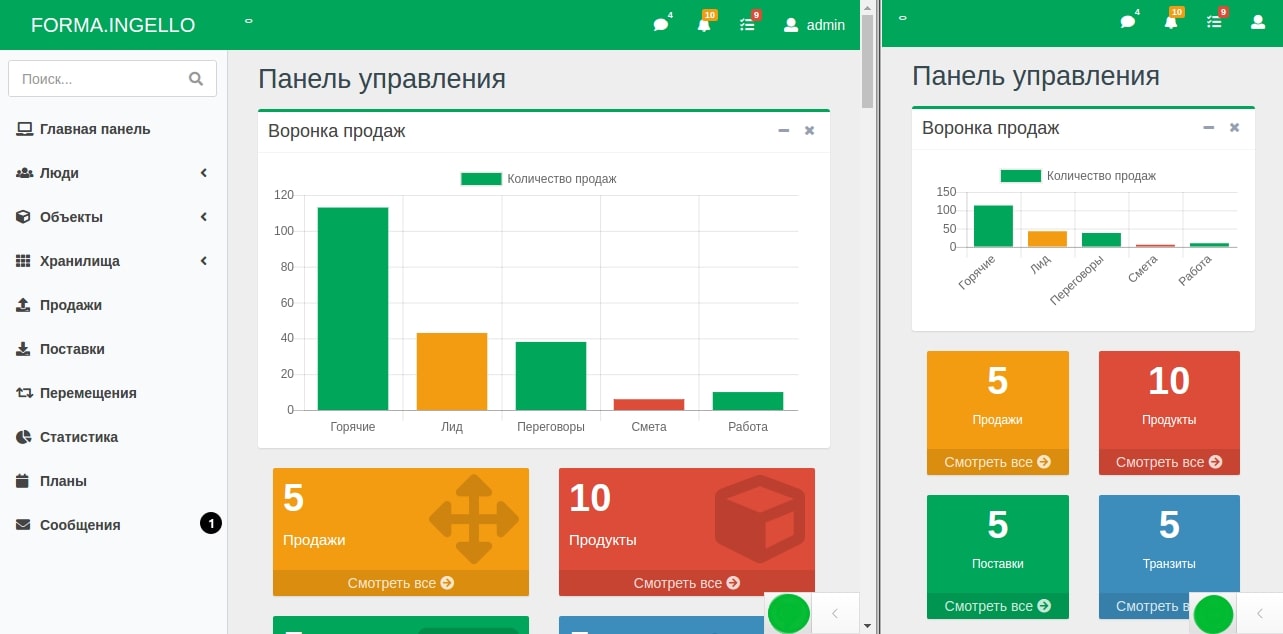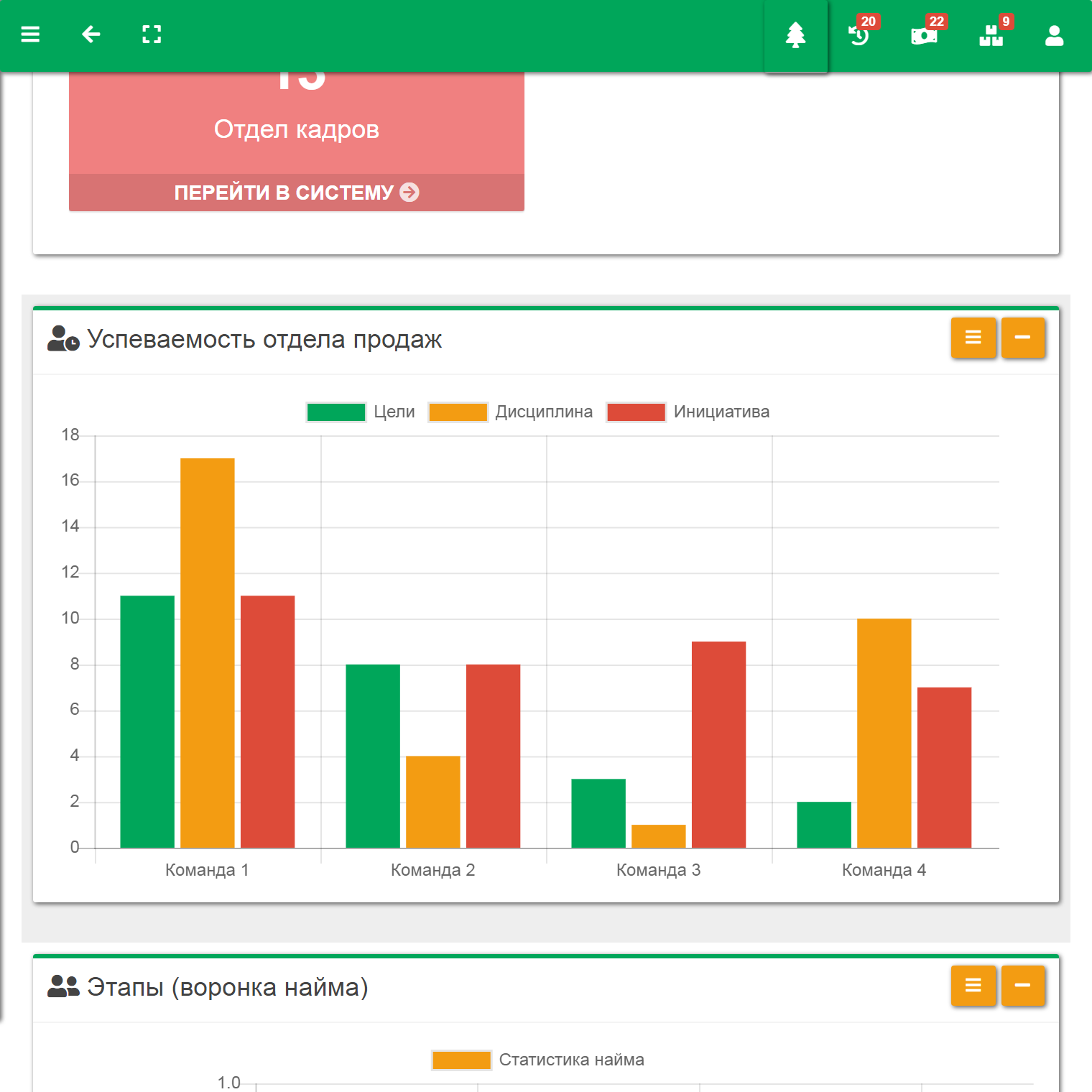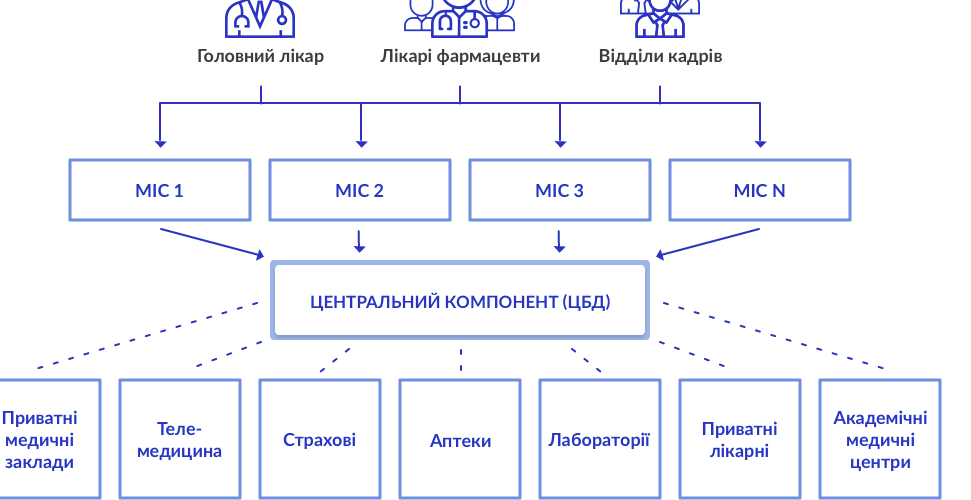
 Разработка ПО
 Менеджмент
 Для компаний
 Для стартапов
 Архитектура ПО
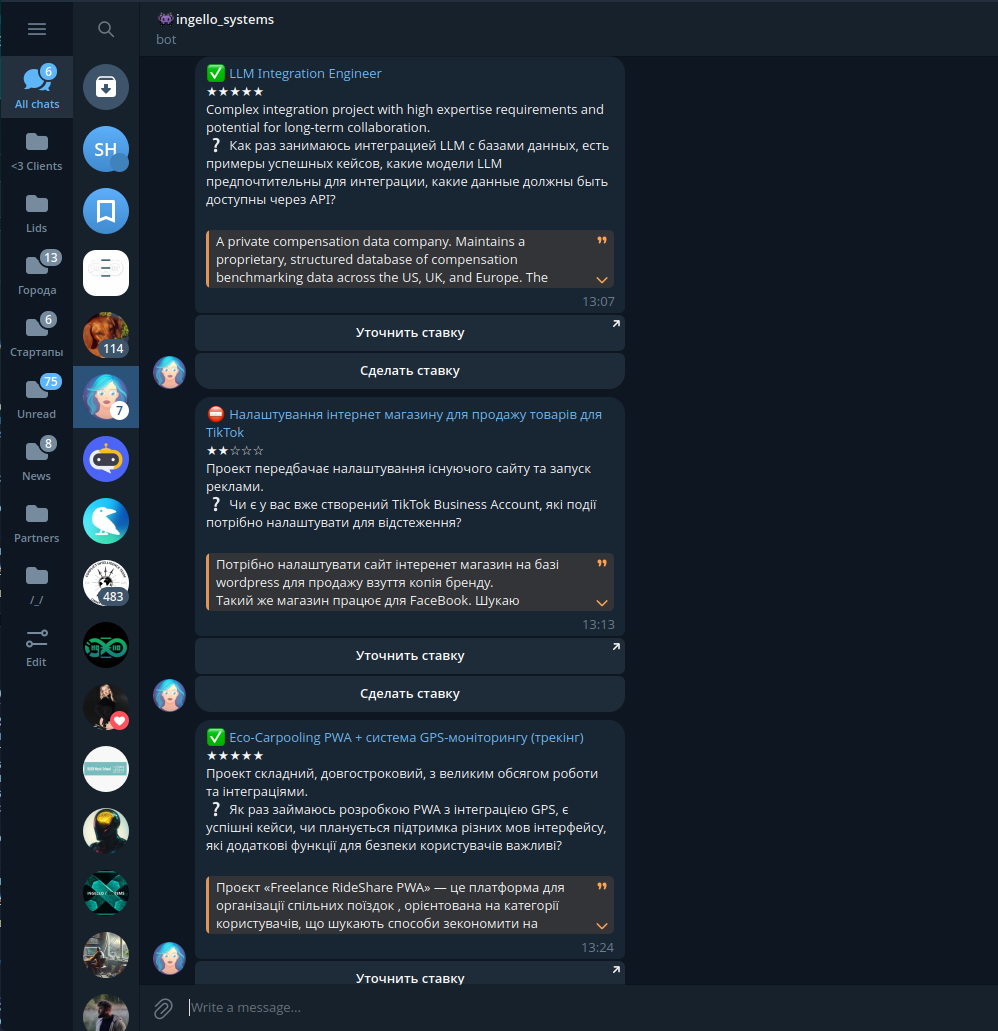
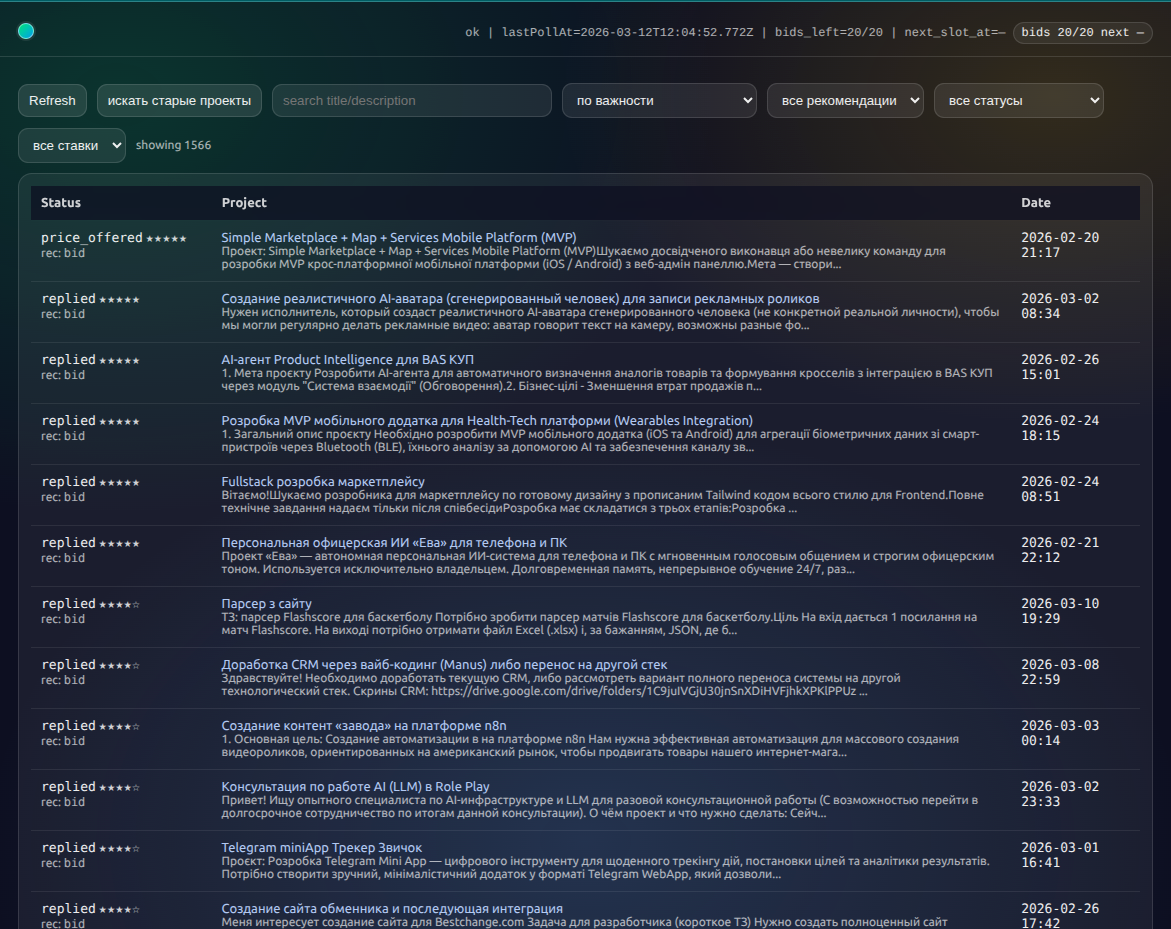
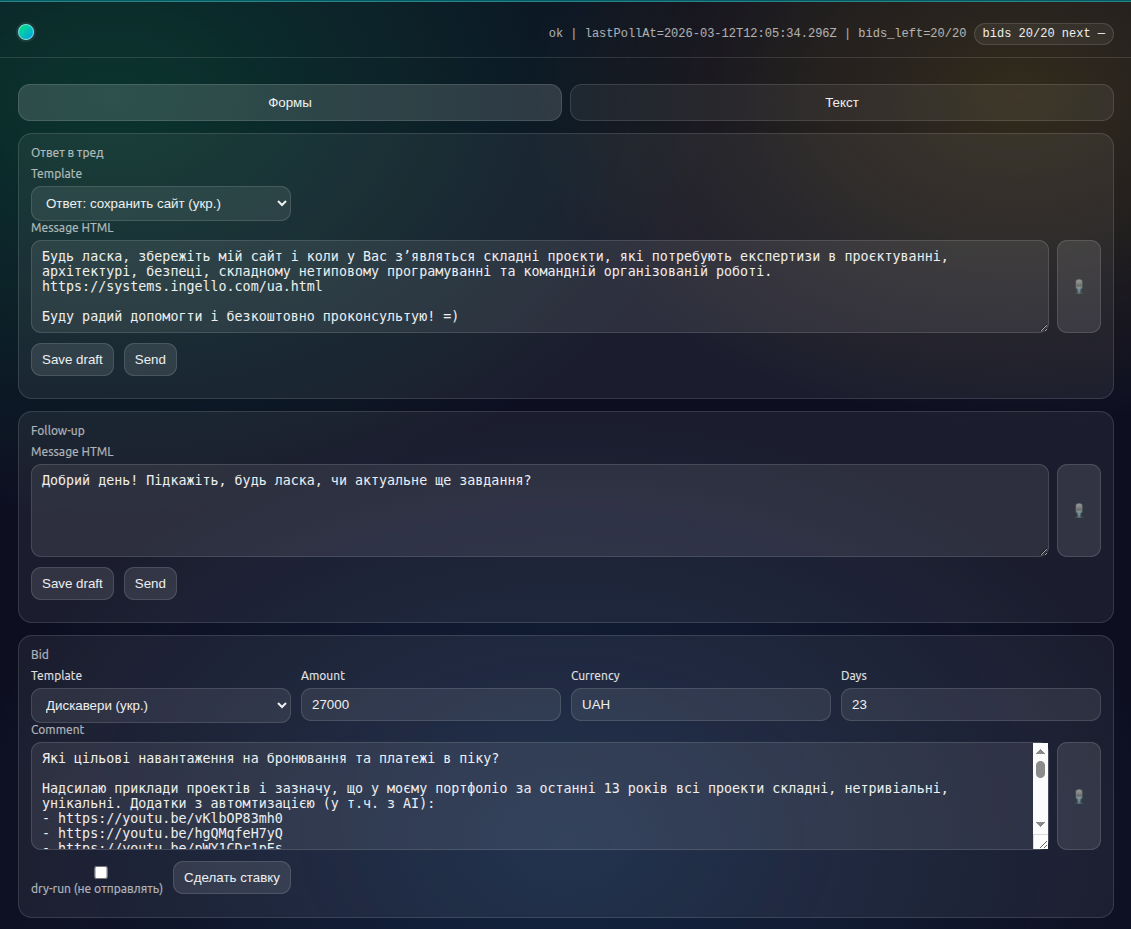
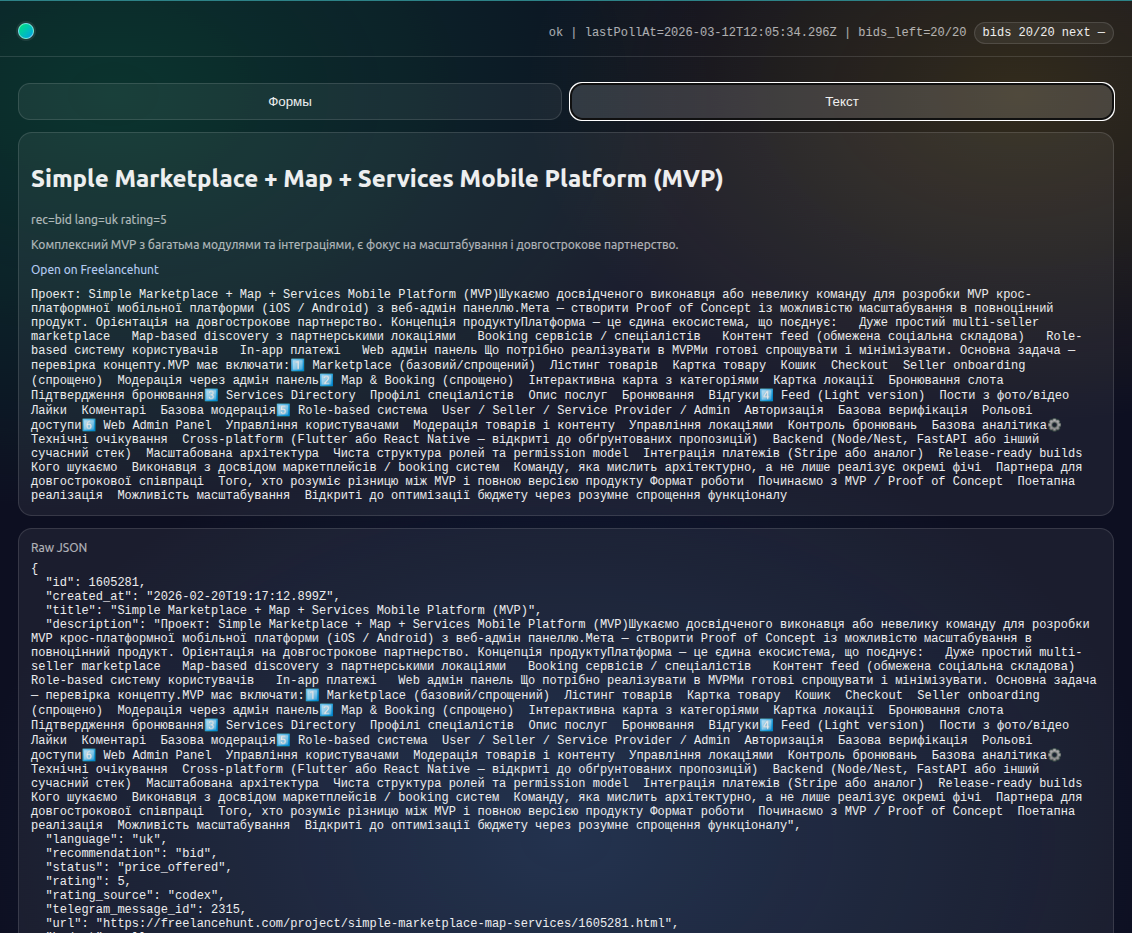
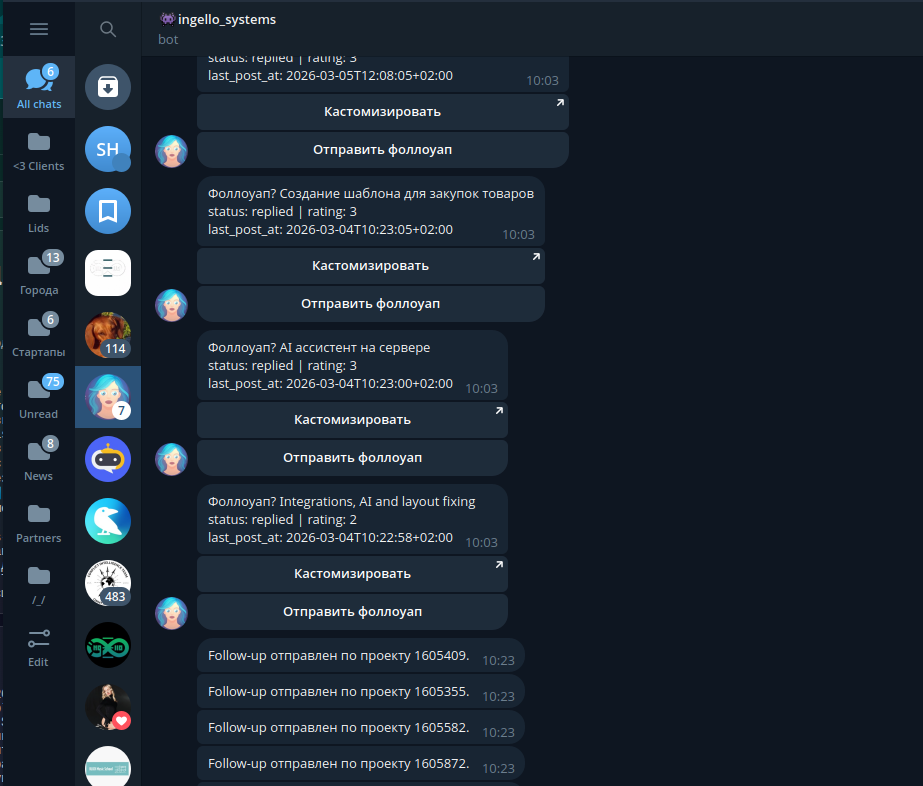
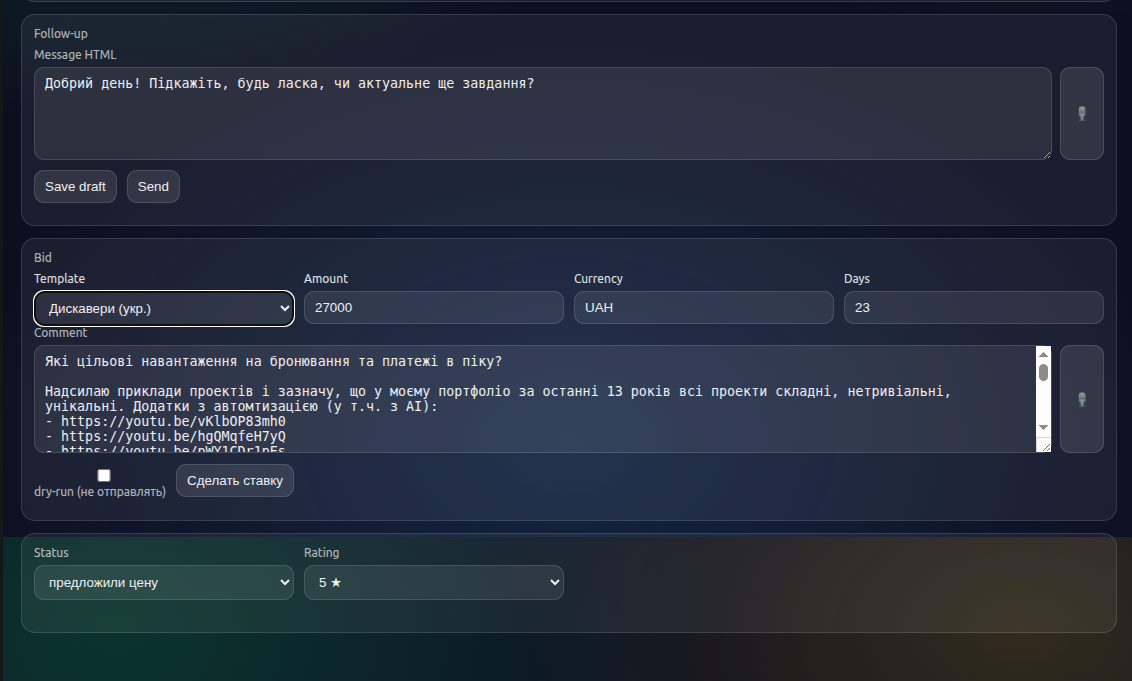
I will show our agent, which replaced 2 people for us (not just "replaced", but does it better, faster, and cheaper!) — works 24/7, monitors projects on different platforms, classifies, reports in Telegram, analyzes the task text, gives recommendations and draws a conclusion, sends notifications to clients, collects templates, instantly reacts to new messages, and maintains a compact CRM with statistics and filters, which can be refined by voice, giving it tasks directly in Telegram! Interesting fact (but do not rush to close the article): the article below was written by AI. I recorded a video, AI recognized the voice, formatted it, found pictures on the internet. Such an experimental project. But more on that next time. Now let us talk about sales automation using modern AI. Believe me, we are truly on the threshold of radically new possibilities; by the way, if it is more convenient for you to listen than to read, there is a link to a video at the bottom where I tell and show everything that will be discussed.
Оглавление
- AI agent for lead generation and sales: Telegram bot, web application, and mobile CRM in one contour
- What exactly such a system does
- Where the real value is here, not the marketing fireworks
- Why it is not enough to simply connect a neural network API
- How the agent’s workflow loop is structured
- When such an AI agent is especially useful
- How this approach differs from hiring an assistant
- Why architecture is more important than hype
- What we usually think through before development starts
- What technologies are usually involved here
- Who such a project is suitable for
- Conclusion
AI agent for lead generation and sales: Telegram bot, web application, and mobile CRM in one contour
Sometimes a business needs not another manager, but a digital partner who does not get tired, does not forget, does not confuse statuses, and does not drown in routine by lunchtime =). This is exactly the contour we design when the issue is not a pretty demo, but a real system for sales, initial lead scoring, follow-up communication, and controlling the flow of requests.
In this project, we show an approach to creating an AI agent for automating customer acquisition. This is not about a toy for one evening and not about a student script that works today and burns the budget tomorrow. This is about a full-fledged software system: Telegram bot + web interface + mobile work scenario + CRM elements + browser automation + AI analysis of the incoming flow.
What exactly such a system does
To put it simply, the agent becomes extra hands for the business. It monitors selected platforms, finds new requests, analyzes their content, filters out junk, helps react quickly, and does not let good leads leak into the drain of operational fuss.
- Monitoring platforms and sources — exchanges, tender sites, catalogs, marketplaces, hiring channels, partner platforms
- AI classification of leads — determining the complexity, relevance, priority, and potential value of a request
- Preparing the first response — not a dumb template, but an adapted text for the project context
- Generating a clarifying question — the very one that actually affects the budget estimate and scope of work
- Follow-up — the agent does not forget to remind the client about itself if the correspondence gets stuck
- Manual control — a person can intervene, correct, confirm, or stop an action at any moment
- Working through the browser — if a platform does not have a convenient API, the agent acts like an attentive user, only without drowsiness and suffering
Where the real value is here, not the marketing fireworks
The main problem of most companies is not that they do not have ChatGPT. The problem is that they have dozens of small actions that eat the day piece by piece, like a school of hungry piranhas. Check new requests. Evaluate relevance. Not forget to reply. Clarify details. Remind in three days. Switch the status. Synchronize this with the CRM. Not lose context.
This is where adult automation begins. Not magic, but architecture — that is, a pre-thought-out system of connections, roles, statuses, constraints, and scenarios. AI in such a project does not hang in the air like a fashionable light bulb, but is embedded into the process and begins to work for the result.
Why it is not enough to simply connect a neural network API
Because connecting an API is not a project. It is only a wire to the socket. And then everything interesting begins: where to store context, how to count limits, how not to burn tokens on what is better solved by classic code, how to track regressions, how to design statuses, how to prevent chaos in the logic of actions.
in real products, several approaches have to be combined:
- Classic algorithms — where clear rules and predictability are needed
- ML models — that is machine learning, when the system needs to catch patterns in data
- LLM and agent scenarios — where language, meaning, interpretation, response adaptation, and semi-autonomous decision-making matter
- Human in the Loop — an approach in which a person remains in the control contour and confirms critical actions
And so Human in the Loop — this is not a brake, but common sense. Especially in sales, B2B communication, tenders, medicine, logistics, and corporate processes, where a mistake costs more than a couple of seconds for confirmation.
How the agent’s workflow loop is structured
Usually we think of such systems not as one bot, but as a multilayered structure. From the outside, it looks simple and even a little bold: Telegram notifications, a minimalist interface, a quick reply to the client, voice input from a phone. But under the hood, there is careful engineering.
- Data collection layer — monitoring platforms, updates, request cards, and user actions
- Normalization layer — bringing scattered data into a unified format
- Analytics layer — scoring, categorization, importance rating, determining the next step
- Communication layer — Telegram, email, internal web interface, mobile scenarios
- CRM logic layer — statuses, follow-up, message history, limits, templates, comments
- Automated actions layer — opening the browser, sending a response, moving through steps, updating cards
- Control and audit layer — logging, manual correction, restrictions, and access rights
It is precisely this decomposition that makes it possible not to cobble together a monster out of sticks and enthusiasm, but to build a system that can be developed for months and years.
When such an AI agent is especially useful
In practice, agent-based scenarios work especially well where there is repeatable routine, a flow of incoming entities, and the need to react quickly.
- Service sales — lead generation, qualification, quick replies, follow-up
- B2B and corporate requests — preliminary task analysis and priority-based routing
- Hiring and recruiting — initial candidate analysis, response funnel, reminders
- Tenders and procurement — monitoring new publications and preparing a response
- Logistics and service companies — request distribution, status updates, communication control
- Medicine and health-tech — routing inquiries, initial categorization, controlling interaction scenarios
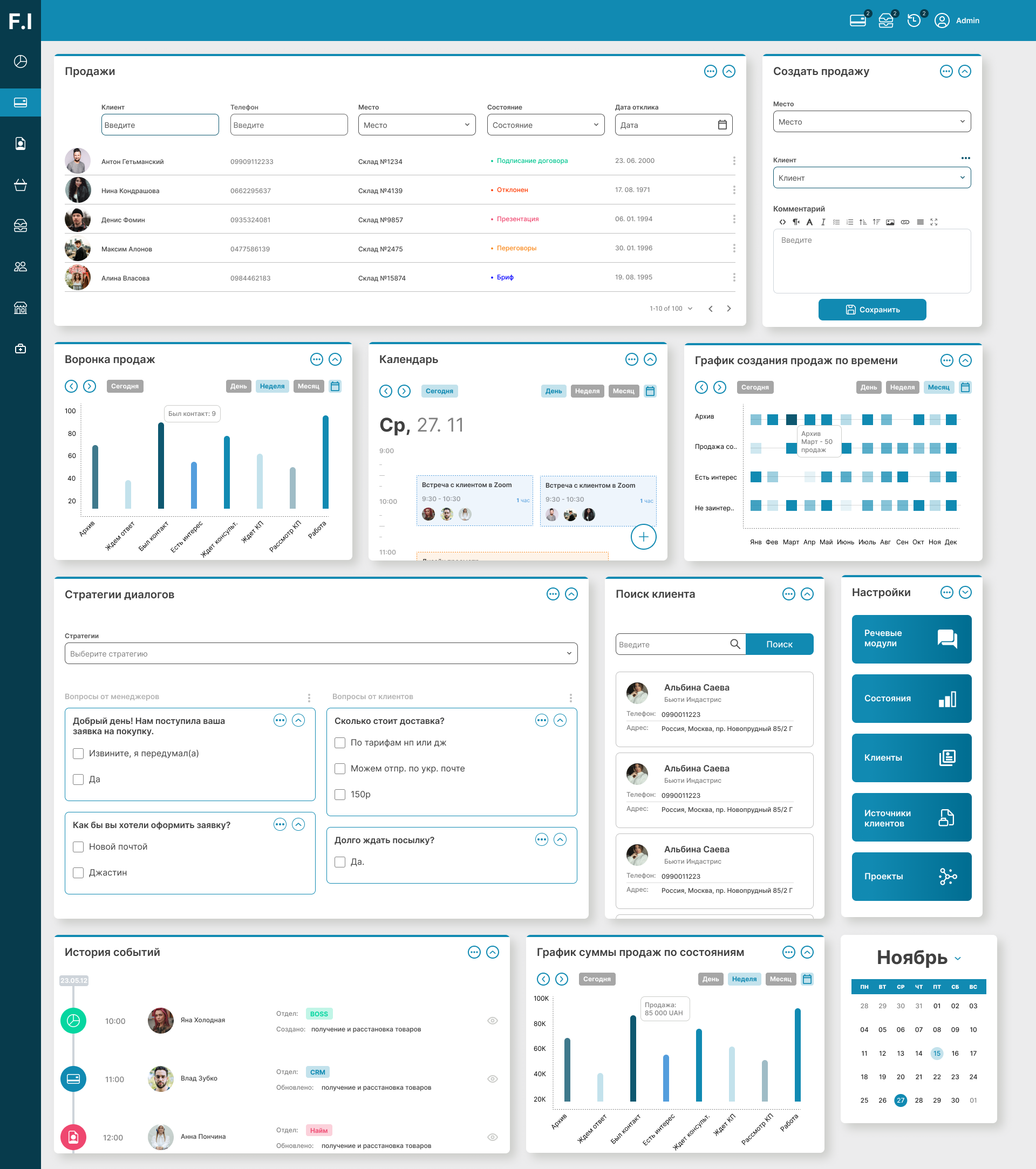
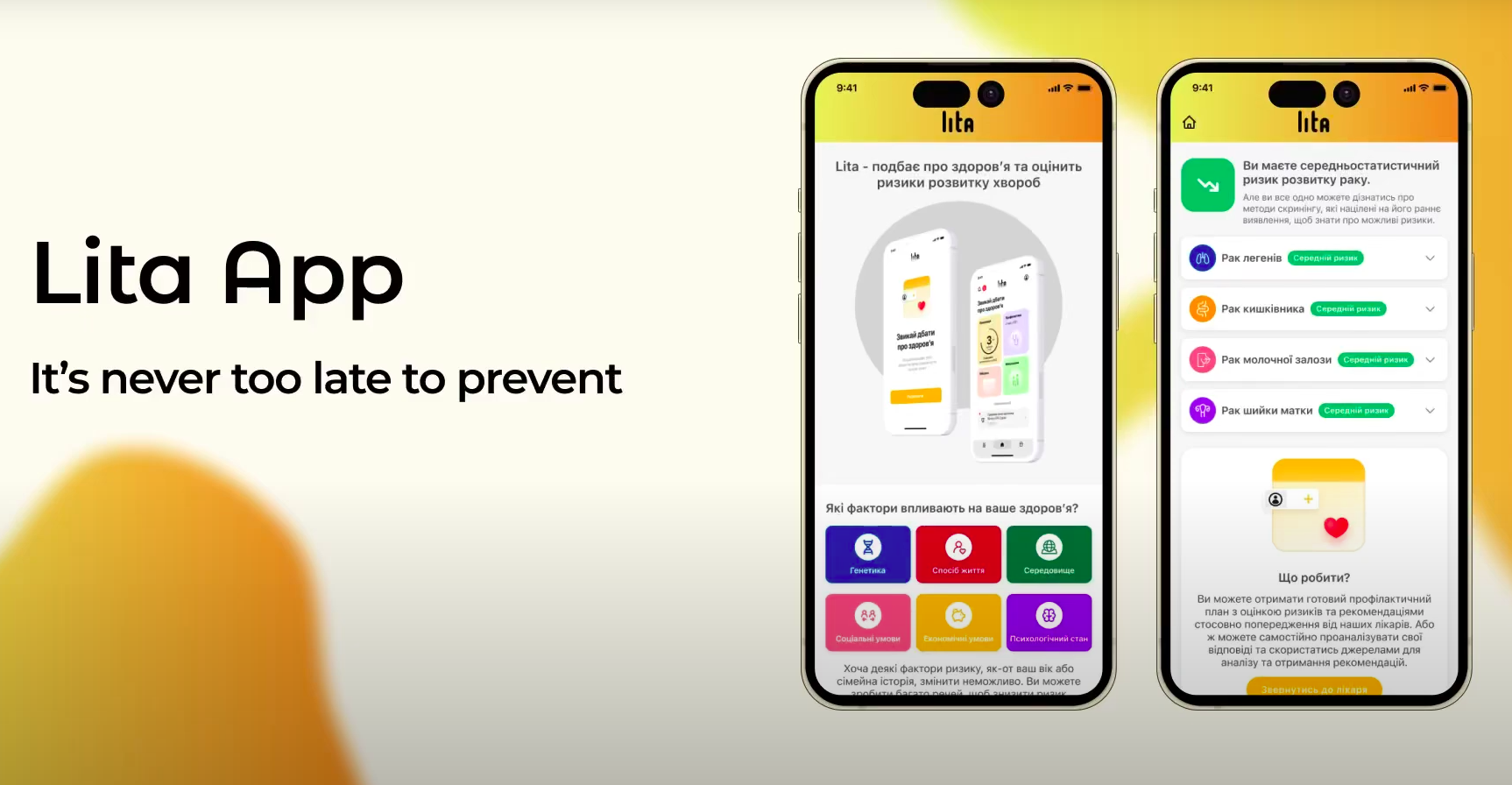
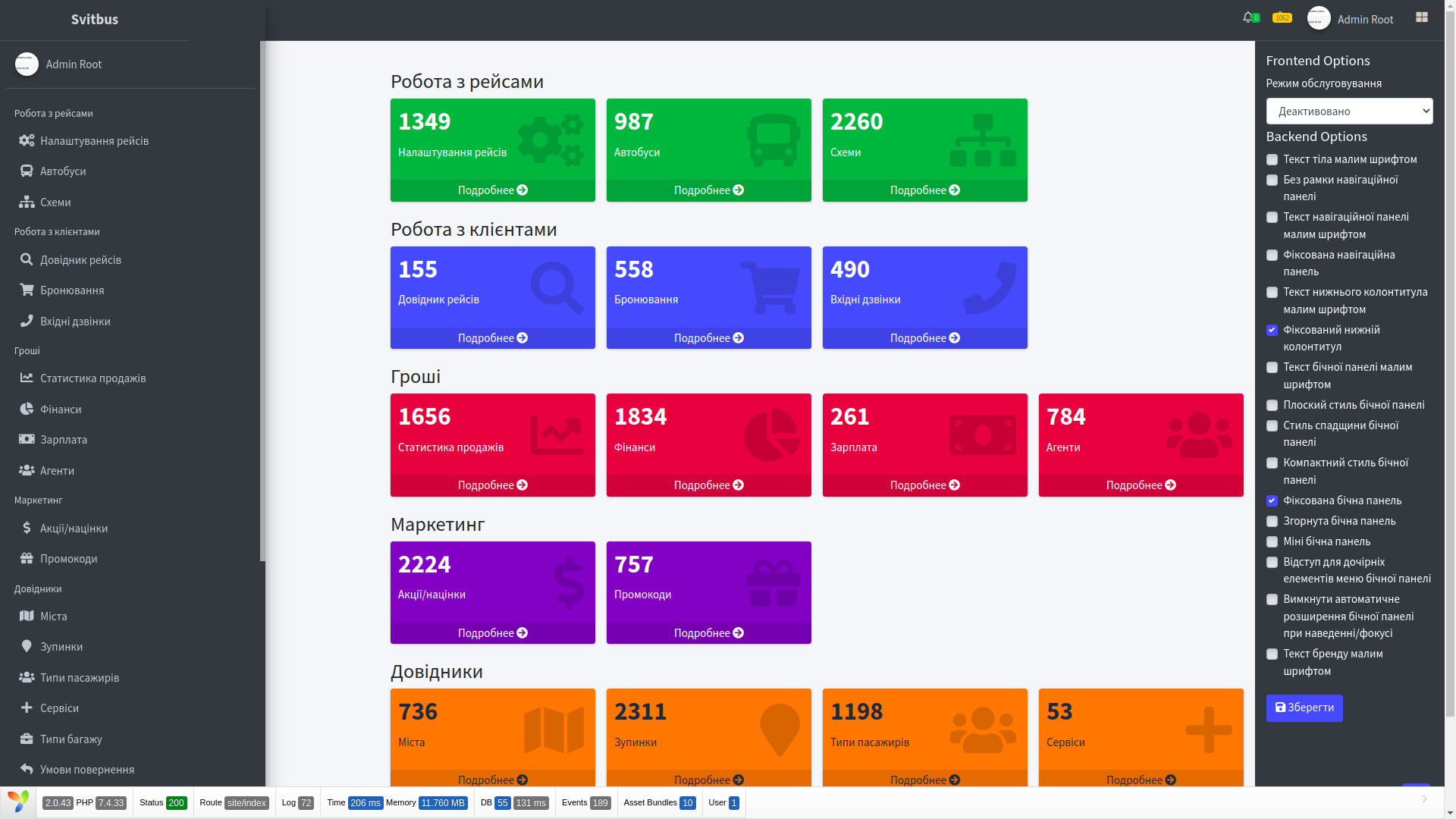
By the way, if the topic of medical and health-tech solutions is close to you, take a look at our cases Lita, L-Doc and designing an MIS for eHealth. And if a corporate operational loop is closer to you, pay attention to FORMA CRM, FORMA BPM and NorthWest.
How this approach differs from hiring an assistant
A live assistant can be useful. But there is a nuance: you need to find them, train them, control them, keep them in context, and put up with human fatigue. An AI agent also has limitations, but it does not forget to do a follow-up, does not lose the thread of the conversation after three calls in a row, and does not mentally go on vacation at the most inconvenient moment =).
At the same time, we are not selling a fairy tale about fully replacing a person. We design a sensible balance between automation and management. Somewhere the agent makes a decision on its own. Somewhere it suggests an option. Somewhere it makes a draft. Somewhere it only signals. Real efficiency lives precisely in this configuration.
Why architecture is more important than hype
Today many people want an AI project in a week. It sounds lively, but usually ends in a familiar way: chaos in logic, a swollen token budget, uncontrolled system behavior, inability to scale, dependence on one person who somehow glued it all together at night on caffeine.
Therefore, the first mature stage is design. We analyze the business process, define roles, data, scenarios, constraints, bottlenecks, automation cost, possible risks, and only then assemble the technical architecture.
It is similar to designing a building: of course, you can buy beautiful doors first. But if you forget about the foundation, the doors will later stand in the middle of a field and sadly symbolize digital transformation.
What we usually think through before development starts
- The agent’s goal — what it should improve: response speed, conversion, qualification quality, team workload
- Autonomy boundaries — what it does on its own, and what only after confirmation
- Economics — costs for models, data processing, support, and scaling
- Reliability — what happens in case of an error, timeout, platform interface change, or instability of an external service
- Data — where the history is stored, how analytics are built, what the system will be able to learn from next
- UX for the team — so that the tool speeds up work instead of turning into yet another panel of suffering
What technologies are usually involved here
Depending on the project, this may be a stack consisting of a web application, mobile interface, CRM modules, AI integrations, task queues, browser automation, speech technologies, and analytics modules.
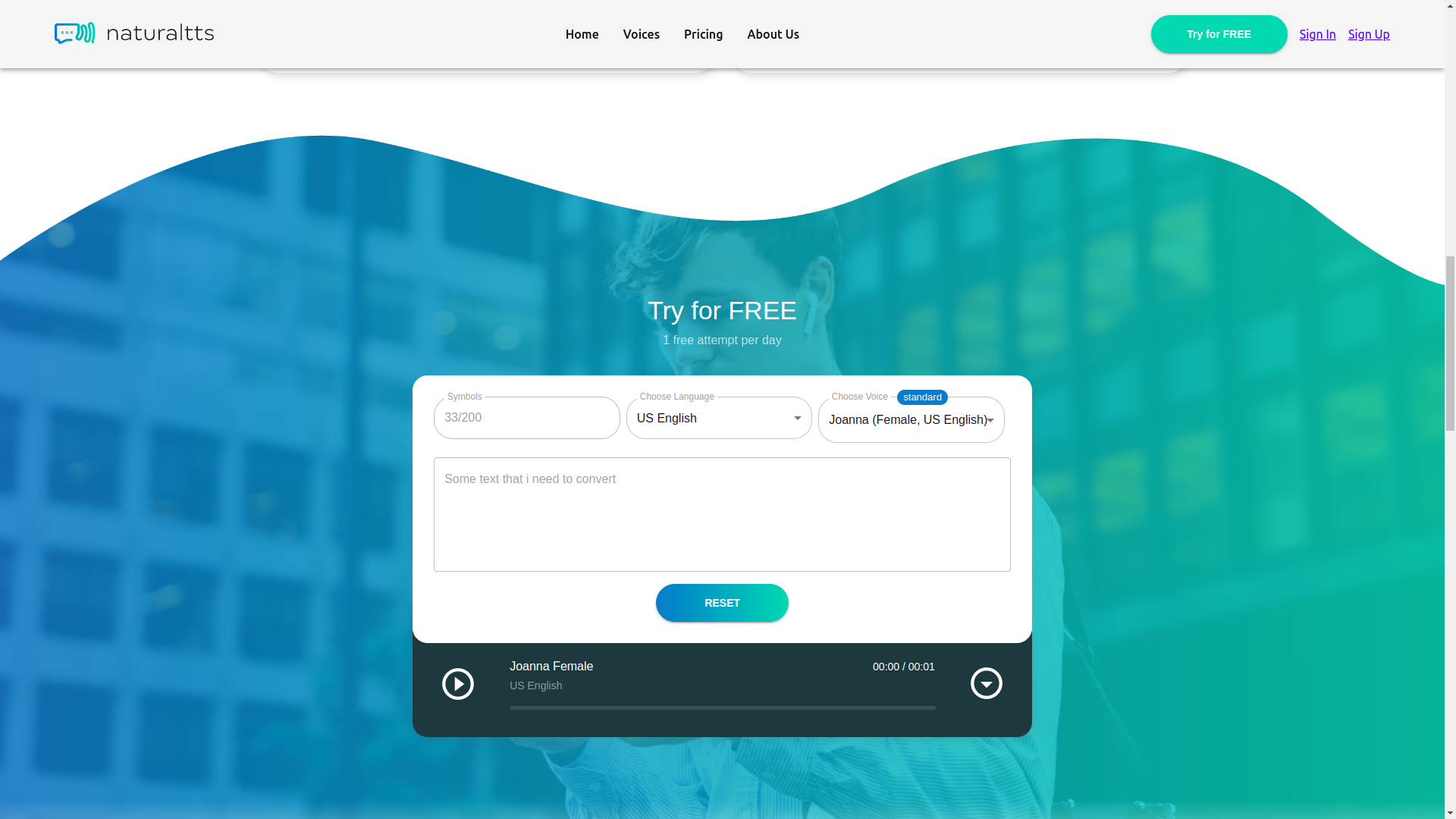
If you are interested in the related topic of development automation and AI modules, take a look at the cases FRACTAL and NaturalTTS. And if you need a loop with roles, statuses, accounts, and corporate logic, it is also useful to look at platFORMA.
Who such a project is suitable for
For startups — when you need to quickly test a hypothesis, assemble an MVP, and not drain the budget into unsystematic experiments. For systematic companies — when it is time to stop keeping critical processes on employee heroics, Excel, and messenger messages.
Such solutions are especially well received by managers who have already had enough of contractors in the format of we will conjure up AI for you right now, and then for some reason everything rests on one script, one student, and one unfortunate administrator.
Conclusion
An AI agent in sales, lead generation, and communication is not just a trendy feature. It is a new operational layer of business. A properly designed agent can simultaneously become a filter, assistant, coordinator, executor, and insurance against routine.
But this only works when behind the beautiful showcase there is strong architecture, a well-thought-out process, and a team that knows how to turn ideas into real systems, not into a slide on a call =).
If you want to discuss your AI project, CRM with agent-based scenarios, automation of sales, hiring, logistics, or internal operations — go to systems.ingello.com. There you can see the approach to work, design stages, reviews, and leave a request for a consultation. We will figure out where you really need artificial intelligence, where classic algorithmization is better, and where a hybrid loop with Human in the Loop is needed.