
 Разработка ПО
 Менеджмент
 Для компаний
 Для стартапов
 Архитектура ПО
In this article, we will talk about what an MVP is, and in the video below I will break down popular misconceptions from the internet. Specifically, why analogies with bicycles, scooters, cars, and trucks more often get in the way than help you understand the essence, where the boundary lies between a prototype, an MVP, and an MMP, why an MVP is not just a stripped-down version of a product, but a tool for testing a key hypothesis, and how to determine the real scope of the first version so you do not spend extra money developing something the market may not need. If you want to understand the topic without confusion, I recommend watching the whole video =)
Оглавление
- MVP in 2026: what it really is, without shamanism and fake importance =)
- Where the term MVP came from in the first place
- What is truly important in an MVP
- Why MVP is understood a little differently in 2026
- What types of MVP exist
- 1. By testing method
- 2. By object of testing
- 3. By launch environment
- What is not an MVP
- How the understanding of MVP has changed in recent years
- How to understand that your MVP has been chosen correctly
- Why it is especially important for startups and system companies to understand MVP correctly
- Examples where an MVP must not be confused with a toy
- A practical formula worth remembering
- When it is better not to argue about terms, but to do it right immediately
- Conclusion
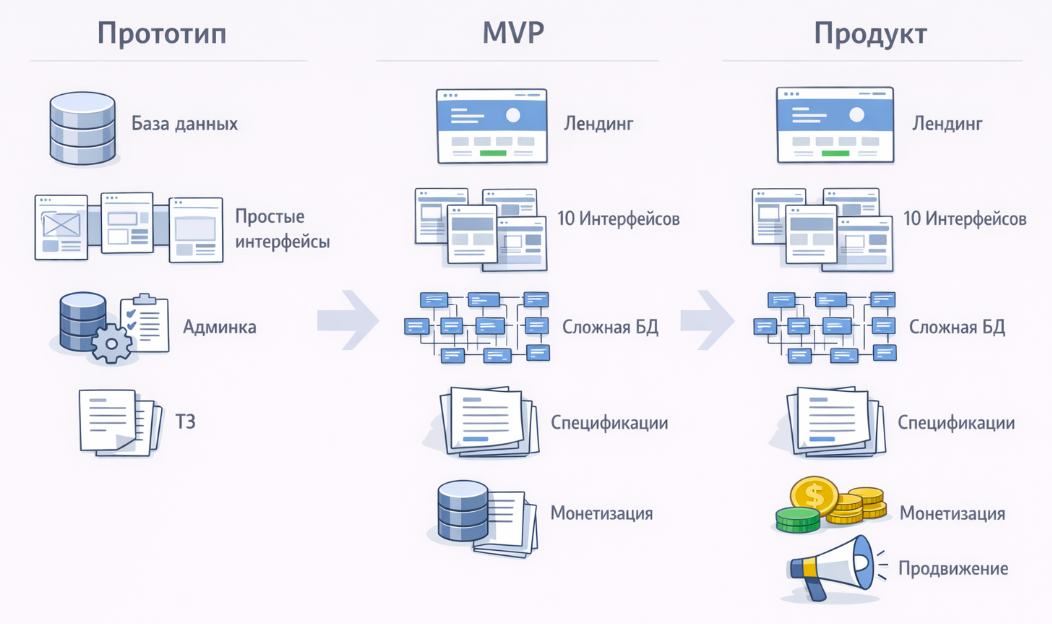
MVP in 2026: what it really is, without shamanism and fake importance =)
MVP — it is not a sacred artifact from the world of startup magic and not an indulgence for releasing a crooked, raw product. It is a practical tool for reducing uncertainty. Simply put: the smallest version of a solution that already gives the user real value and helps test the riskiest hypothesis.
And this is usually where the circus begins. Some call an MVP a landing page with a button, others call it a half-finished system that takes six months of development, and still others call it any demo assembled with vibe coding over a weekend. Formally, everyone puts on an intelligent look, but in essence many simply confuse experiment, prototype, PoC (proof of concept, that is, checking technical feasibility) and first commercial release.
A normal adult definition sounds like this: MVP is the smallest-in-scope version of a solution that already brings real benefit to the target user and allows the key hypothesis to be tested with minimal costs in time, money, and organizational pain.
IN THE VIDEO I WILL SHOW HOW THE MODERN INTERNET EXPLAINS MVP AND WHY THIS IS A MISCONCEPTION:
Where the term MVP came from in the first place
The term has a historical primary source, but there is no single global ministry of truth that would have permanently cemented one canonical interpretation. The origin of the term is usually associated with Frank Robinson / SyncDev, while Lean Startup and especially Eric Ries gave the concept broad popularity. The origin of the term is also separately confirmed by Harvard Business School materials and a Productboard overview.
That is, there is a source. But then the term, as often happens with useful ideas, was happily pulled in different directions by people. So today MVP is not so much a strictly formal scientific category as a working product term, which is important to explain correctly in the context of the task.
What is truly important in an MVP
An MVP has three mandatory parts. If you remove even one of them, you get something else.
- Minimum — not poor, not ugly, not sloppy, but simply as small as possible without losing the essence.
- Viable — the user must receive value in reality, not just see a beautiful mockup in Figma and go home.
- Hypothesis-testing — an MVP is made not for the release as such, but for learning. It must clear the fog around the most dangerous question: whether the product is needed, whether the value is clear, whether people are ready to pay, whether it can be delivered economically and technically.
That is exactly why an MVP starts not with features, but with risk. First you determine where you have the biggest gap in understanding the market, user behavior, economics, or technology. And then you build a minimal but real way to test that gap.
Why MVP is understood a little differently in 2026
In 2026, the emphasis has noticeably shifted: teams used to discuss more often what minimum set of features to release, while now they increasingly talk about what minimum valid experiment for delivering value. The reason is simple and even a little funny: code has become faster to produce, while thinking — strangely enough — is still hard =)
AI has accelerated prototyping, interface generation, code writing, demo assembly, and even partially architecture preparation. But a quickly assembled artifact does not automatically become an MVP. If you do not have:
- a clear hypothesis,
- a clear target audience,
- a success metric,
- a decision criterion,
then you do not have an MVP, but just something assembled very quickly. Sometimes pretty. Sometimes expensive. Sometimes useless.
So in 2026, a good explanation of MVP sounds like this: it is a minimally sufficient way to test the riskiest product hypothesis on real users while preserving real value and measurability of the result.
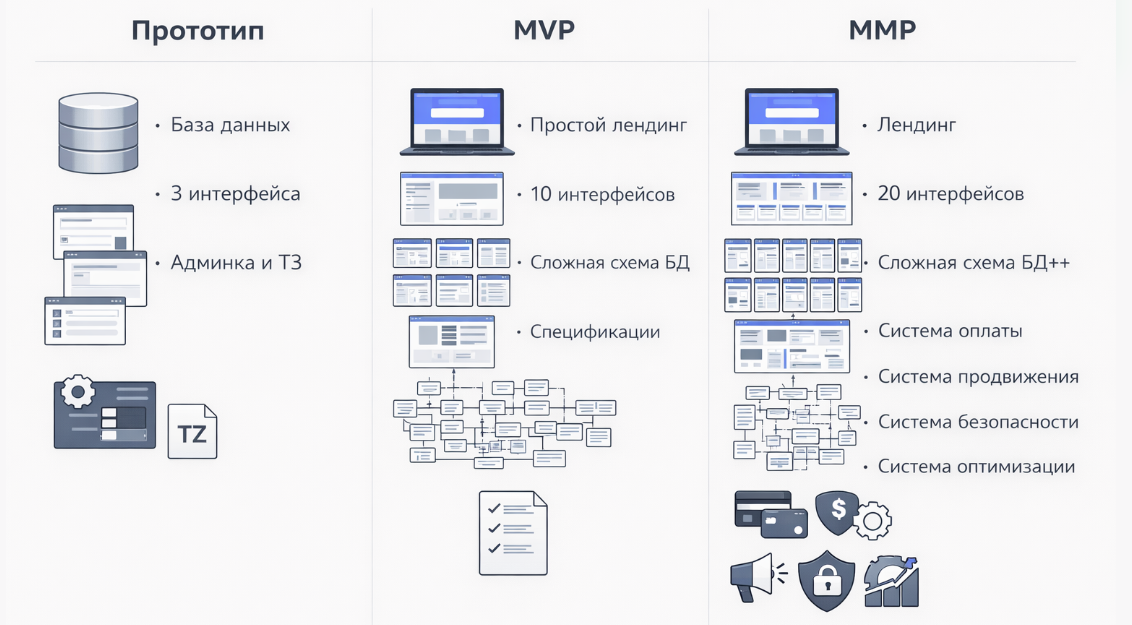
What types of MVP exist
There is no single official classification, but in real work it is convenient to divide MVPs into several types.
1. By testing method
- Functional MVP — a working product with a minimal set of key functions. A classic of the genre.
- Concierge MVP — value is delivered manually. No magic, no automation, but demand itself and the scenario are tested quickly.
- Wizard of Oz MVP — everything looks automated from the outside, while inside people do half the work. An excellent way to test user behavior before heavy development.
- Smoke Test / Landing Page — testing interest through a landing page, waiting list, ads, a button, a fake option. Many call this an MVP, but technically it is more often an experiment, not a full-fledged MVP, because real value is not yet delivered to the user.
2. By object of testing
- Value MVP — testing whether the value itself is needed.
- Usability MVP — testing whether people understand the interface and scenario.
- Business MVP — testing willingness to pay, the monetization model, and acquisition economics.
- Technical MVP — testing whether the solution can be delivered at all with the required speed, quality, and cost.
3. By launch environment
- B2C MVP — emphasis on mass behavior, funnel, retention, and a self-serve model.
- B2B MVP — more often this is a narrow pilot with high customization, manual work, and close feedback.
- Internal MVP — a solution for an internal team or company processes, where there is no external market, but there is a value hypothesis.
What is not an MVP
This is usually where it is useful to cut through the confusion immediately, without mercy.
- PoC is not an MVP. A PoC proves that the thing is technically possible.
- Prototype is not an MVP. A prototype is needed to show, discuss, test an idea or UX scenario.
- A pilot is not necessarily an MVP. A pilot is a limited implementation in a real environment, often already after an MVP or based on it.
- Just the first version of a product is not always an MVP. If you spent six months building half a system without a clearly testable hypothesis, it is not an MVP. It is just a small release with a big hope for a miracle.
How the understanding of MVP has changed in recent years
About 10 years ago MVP was often understood crudely: a stripped-down first version, faster release, fewer features.
About 3 years ago a more mature interpretation dominated: a basic working version of a product with core features for early users.
About a year ago people began to distinguish more strongly between MVP, prototype, pilot, and discovery artifacts. Especially in B2B and enterprise environments, where confusing a beautiful presentation with a validated value delivery model is too expensive.
In 2026 it is most useful to explain MVP as a minimum viable experiment for delivering value, not as a minimum piece of code. This is a more accurate, practical, and less toxic formulation.
How to understand that your MVP has been chosen correctly
A good MVP answers one most dangerous business question. Not twenty. Not all at once. Exactly one main question.
- Does the user have a real pain?
- Does the user understand the value of the solution?
- Is the user ready to change behavior?
- Is the user ready to pay?
- Can this value be delivered without destroying the project economics?
If your MVP does not provide a measurable answer to at least one of these questions, then it is either decorative development or engineering meditation. And business, as a rule, needs not enlightenment, but clarity.
Why it is especially important for startups and system companies to understand MVP correctly
For a startup, misunderstanding MVP is a classic way to burn money beautifully, quickly, and to motivating music. For a system company, it is even more fun: there you can not only miss the mark on the product, but accidentally build a digital Frankenstein that will automate chaos instead of order.
We see this constantly in projects where the business needs not just to draw an interface, but to design the architecture (that is, the skeleton of the system), define roles, scenarios, integrations, data, reporting, constraints, and the point of real benefit.
Therefore, when it comes to serious MVPs for business, it is useful to look not only at screens, but also at how the system will live afterward: how the domain model is built, where the source of truth for data will be, what integrations are needed, how scaling is ensured, and how not to drown in manual operations three months after launch.
Examples where an MVP must not be confused with a toy
When we design products for complex niches, an MVP rarely looks like a toy demo. Sometimes it is a narrow but already truly working part of the system.
-
In FRACTAL, the topic of development automation and AI modules cannot tolerate verbal fog at all: what matters there is not to show a beautiful idea, but to quickly test usefulness, usage scenarios, and real labor savings. In transport and booking systems like Svit BUS or Yacht Booking, the MVP must provide real value already on the user's route: search, selection, booking, payment, refunds, roles, accounting. In corporate products and process automation, for example FORMA BPM or platFORMA, a mistake in the MVP often costs more, because poor hypothesis framing then spreads across the entire architecture. In medical and regulatory products like Evrika or Lita, speed must not be confused with irresponsibility: viability there is not only value, but also compliance with processes, data, regulatory constraints, and security.
That is exactly why a good MVP is not minimalism for the sake of minimalism. It is a precise engineering strike against uncertainty.
A practical formula worth remembering
An MVP is the smallest version of a solution that already gives the user real value and allows the team to test the riskiest hypothesis in a measurable way.
And immediately after that, it is useful to reinforce it with a second point: do not confuse MVP with PoC, a prototype, or just a stripped-down release. An MVP is defined not by the number of features, but by what uncertainty it removes.
When it is better not to argue about terms, but to do it right immediately
Honestly, most problems are not in the word MVP itself. The problem is that teams start with interfaces and wishlists, not with hypotheses, constraints, and architectural logic. And then they are surprised why the system turned out like a cabinet assembled from parts of three different kitchens =)
If you are launching a startup, an internal product, a B2B service, or a complex digital system, the right start usually looks like this:
- identify the main product uncertainty,
- describe the target audience and value scenario,
- choose the minimum testing format,
- think immediately about data, roles, integrations, and metrics,
- do not build unnecessary things ahead of time.
At this stage, it is especially useful to have not just a code contractor, but a team that knows how to help formulate hypotheses, design architecture, stage development, and fix the boundaries of the MVP.
If you need not an abstract conversation about MVP, but normal applied work: break down an idea, identify the risk, design the first outline of the system, estimate stages, and turn chaos into a clear plan — this is exactly the case where it is worth looking at how we approach the design and launch of complex products. No magic there, but with architecture, staging, and a human attitude toward reality.
Conclusion
MVP in 2026 is no longer just a stripped-down first version of a product. It is a minimum viable way to test value on real users. Not a set of randomly cut features, not a slide in Figma, not a demonstration for an investor under a beautiful voiceover.
A good MVP does not look small for the sake of saving money. It looks precise. Like a scalpel, not like an axe. And that is exactly why it helps not just to enter the market faster, but to enter it smarter.