When I say that we automate managers' work, the room usually goes quiet. Managers tense up because they hear "you will be replaced". Owners perk up because they hear "we can cut payroll". Both hear the wrong thing. In all my years of practice I have not seen a single company where a system fully replaced a good manager. But I have seen dozens of companies where managers spent two thirds of their working day on things a machine does better, faster and without stress, while actual management got only scraps of time between meetings.
What a manager actually does
If You break a manager's working day down into operations, the picture is unexpected. He collects information: who did what, where things got stuck, how much was sold, how much is left in stock. He compiles it into reports, often by hand, copying numbers from five places into one spreadsheet. He reminds people about deadlines. He distributes tasks by looking at who is busy right now and who is not. He approves, forwards, clarifies. And only somewhere in between does he make the decisions he was actually hired for.
At its core, management is making decisions based on information. And collecting, compiling and delivering information is exactly what machines do best. The result is a funny situation: the manager does the most valuable part of the work in bits and pieces, while carrying the most mechanical part all day long. It is as if a restaurant's head chef spent half of every shift peeling potatoes. Potatoes need peeling, of course. Just not by the head chef.
What can be handed to the machine
Here is where automation in management already works today and pays off fastest:
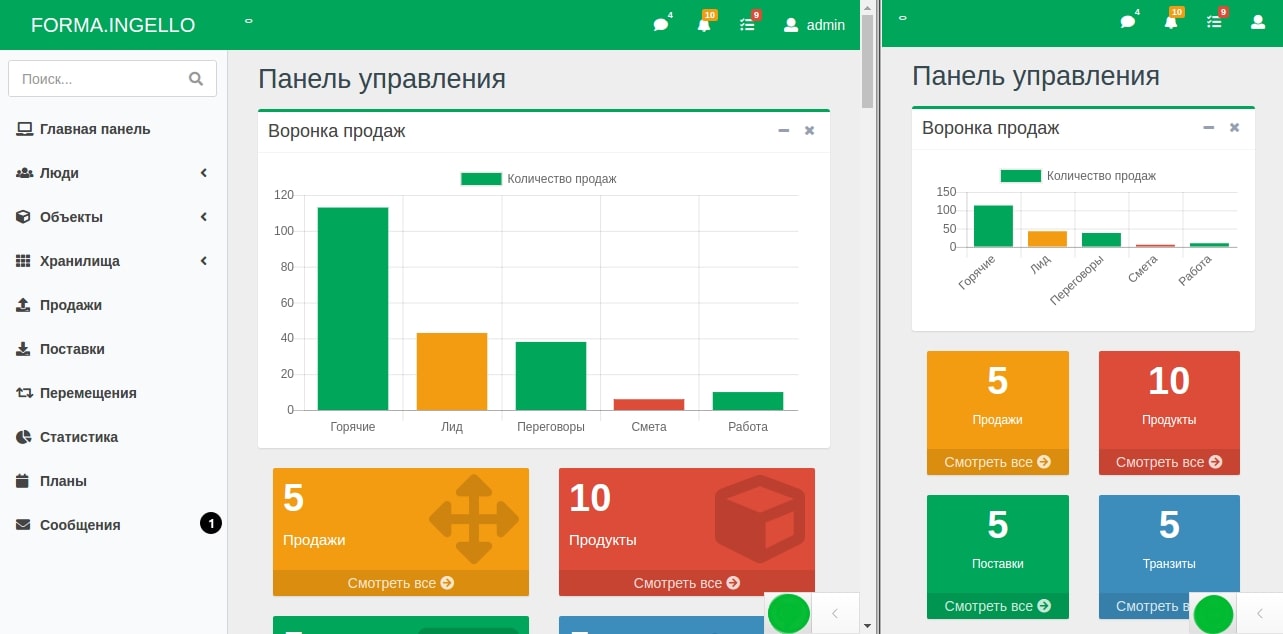
- collecting and visualizing reports: sales, workload, finances and deviations from plan are gathered automatically and shown on one screen, instead of being compiled by hand every Friday;
- deadline control: the system itself sees that a task has been hanging longer than it should, reminds the assignee and, if needed, escalates;
- workload distribution: new requests and tasks are assigned by rules that take into account who is free right now and who has the right skills;
- approval routing: a document travels along the chain of the right people by itself, instead of wandering through email with the question "did you see this?";
- anomaly signals: sales dropped sharply in one region, returns of one product went up, a client has not ordered for a long time, and the manager learns about it immediately, not at the end of the quarter.
ERP, CRM and BPM systems have been able to do all this for a long time. They do not make decisions instead of the manager. They make sure decisions are made on fresh data rather than on feelings and outdated reports.
What must not be handed to the machine
Here I am conservative. A machine counts brilliantly but understands people poorly. Team motivation, a conflict between two senior employees, a conversation with a client who is about to leave for a competitor, the decision about which market to enter next year: all of this is a human's job. Not because technology has not matured enough, but because responsibility matters here. You cannot fire a system for a wrong strategic decision, but You can fire a person. And that is exactly why the decision has to stay with a person.
Automation does not replace the manager. It frees him from the role of a courier between spreadsheets and gives him back the role of a leader.
There is also a subtle point that is rarely mentioned. When routine moves into the system, a weak manager has nowhere left to hide. He used to be busy: compiling reports, forwarding emails, sending reminders. Now those activities are gone, and only one question remains: what decisions does he make and what do they lead to. For a strong manager this is liberation. For a weak one it is a test. And frankly, for the company it is a useful X-ray as well.
The human factor in routine
I would put the main goal of management automation like this: remove the human factor where it does harm and keep it where it is irreplaceable. In routine the human factor is harmful: forgot to remind, mixed up a number, missed an overdue task because of a vacation. In decisions it is irreplaceable: intuition, experience, understanding of people, the ability to see what is not in the data.
A good management system resembles an airplane's instrument panel. The pilot does not measure altitude, speed and remaining fuel by hand, the instruments do it for him constantly and precisely. But where to fly, when to land and what to do in a thunderstorm is the pilot's decision. Nobody thinks the instruments replaced the pilot. Without them he would simply be flying blind.
Where to start
Ask Your managers to write down for a week what their time goes to. No judgments, no punishments, just an honest list. Then mark everything related to gathering information, compiling reports, reminders and forwarding. Usually it is more than half. That is Your potential: not cutting people, but giving them back time for management.
Then automate one area at a time: reporting first, because it gives the fastest effect, then deadline control, then task distribution. In Forma, our ERP platform, these things are already assembled in the sales, projects, hiring and planning sections, and when a company's processes are special, at Systems we design a dedicated loop for them. But the goal is always the same: for the manager to become again who he was hired to be. A person who makes decisions, not a person who hunts for numbers.