Every company that has lived for more than a couple of years has its own zoo of programs. Sales run in one CRM, the warehouse in another system, personnel in HR's spreadsheets, tasks in a messenger, finances in the accountant's own program, and once a month a single very tired person assembles the summary report for the owner by copying numbers out of five windows. I have seen this zoo dozens of times, and every time it grew not out of anyone's stupidity but out of honest logic: each problem was solved when it hurt, with whatever tool was at hand. That is how old cities grow: every district was built in its own time for its own needs, and then it turned out there are no proper roads between them.
Forma appeared at Ingello precisely as an answer to this zoo. It is Ingello's ERP platform, and its motto sounds boring but honest: stability and formalisation. Let me explain what that means in practice and why I believe many companies need not another program but one model of the business.
A digital model, not a set of programs
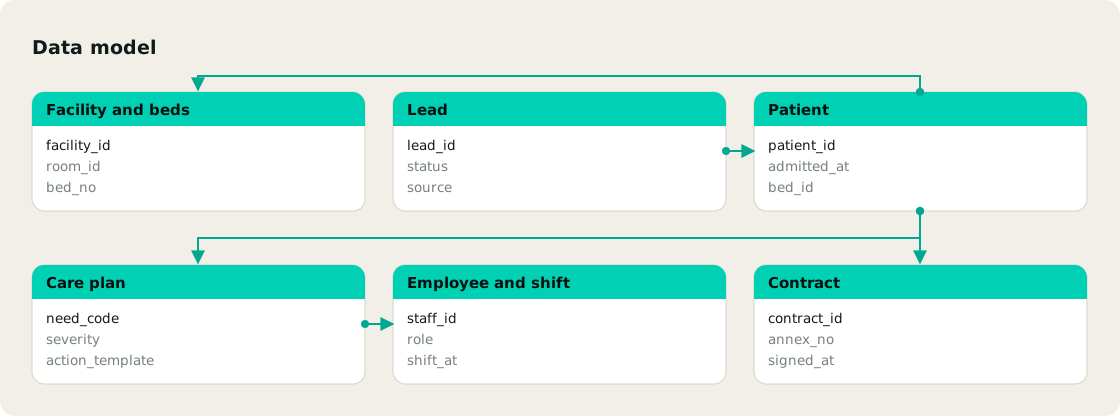
The main idea of Forma is that the system describes the company as a single organism. The customer who bought a product is the same customer the product was shipped to from the warehouse, and the same one a manager will call a month later with an offer. The employee hired through the vacancies module is the same employee who closes tasks in a project and appears in the sales report. A product bought from a supplier, shipped in transit, put on a shelf, counted during inventory and sold is one and the same record, not five similar records in five different databases that start disagreeing on the third day.
It sounds obvious, but this is where most of the losses in a mid-sized business live. When data is stored in different places, it inevitably drifts apart, and people spend hours reconciling and arguing over whose number is right. When data lives in one model, there is nothing to argue about: there is one truth, and the only question is who sees which part of it.
What Forma is made of
Forma is modular, and that is a matter of principle. A company does not have to roll everything out at once. It can start with what hurts the most and connect the rest as it grows. The main sections are these.
- Sales and customers (the CRM section): funnels, deals, communication history, repeat sales.
- Purchasing and suppliers: supplier orders, transit, goods receipt.
- Warehouse and inventory (the WMS section): stock, transfers, counts, discrepancies.
- Products (the PDM section): catalog, attributes, composition, prices.
- Personnel and vacancies (the HRM section): hiring, employee cards, roles and access.
- Projects, tasks and events (the BPM section): planning, assignees, deadlines, calendar.
- Overhead costs, messages, statistics and reports for the owner.
It is important to understand that CRM, WMS, HRM, PDM and BPM here are not separate programs somehow integrated with each other, but sections of one system working with shared data. It is like different departments in one building with shared corridors, rather than five offices at opposite ends of the city with a courier carrying folders between them.
Why formalisation is not the enemy of flexibility
When I say the word "formalisation", some owners wince. They hear bureaucracy, forty-page procedures and a ban on any movement without a signature. I understand the reaction, but the meaning is the opposite. Formalising a process means describing it so that any trained person can carry it out, not only Mary from accounting who has worked here for twelve years and remembers everything. While the process lives in Mary's head, the company rests on her. When Mary goes on vacation, the company limps. When she leaves for good, archaeology begins.
A formalised process does not prevent change, it actually helps: You cannot improve what has not been described. Jazz musicians improvise brilliantly, but each of them spent years learning scales, chords and forms. Improvisation lives on top of form, not instead of it. Forma sets the scales for the business, and the improvising in sales, product and marketing is left to You.
When Forma fits and when it does not
I will not claim that Forma fits everyone, that would be untrue. It works well for companies with standard accounting needs: sales, purchasing, warehouse, team, projects. Trade, distribution, mid-sized manufacturing, service companies. For them, "taking Forma" means getting a proven foundation for an accounting system and adapting it to their specifics instead of designing everything from scratch.
If the business is truly unusual, for example it has unique product logic that cannot be described with standard entities, then we design the system individually, and that is where our Fractal generator comes in, building code, database and interfaces from a description. Quite often the result is a combination: an accounting core on Forma, with the unique part generated separately and connected to it. The decision is always made after analysing the processes, not from a catalog.
Where to start
If You recognised Your company in the description of the program zoo, here is my advice. On a single sheet of paper, draw the path of money and goods through Your company: from the first contact with a customer to receiving payment and shipping. Mark every place where data is carried from one program to another by hand. Every such place means lost hours, errors and arguments over whose number is right. If there are more than three of them, You do not need yet another program for yet another department, You need a single model.
You can get to know Forma at forma.ingello.com, and if You want to look at Your case in detail, at Ingello we run this kind of process analysis as a separate stage, after which it becomes clear what to take ready-made and what to build. Stability to You and order in every process, colleagues.