When an owner invites me to look at his sales department for the first time, I usually ask for one thing: show me a customer who called three months ago, asked for a price and disappeared. What is going on with him now? Who spoke to him? What was agreed? Why did he not buy? Nine times out of ten there is no answer. The salesperson who spoke to him might remember. Or might have already left. No record, no reminder, no next step. A customer the company paid to attract through advertising has simply dissolved. And every company has hundreds of them.
This is where systematising a sales department begins. Not with choosing a program and not with pretty funnels in a presentation, but with a simple admission: we lose customers not because we do not need them, but because we forget about them.
A chaos of calls and an order of deals
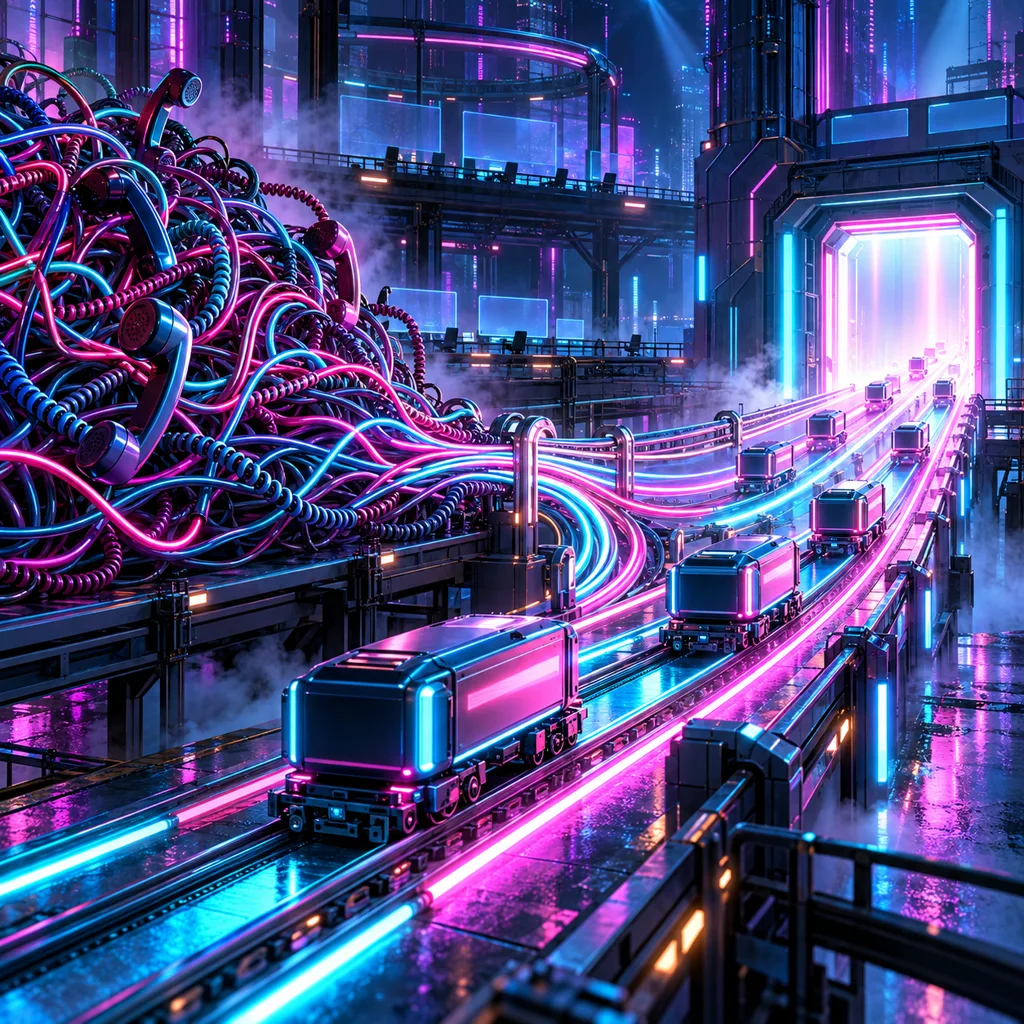
Sales without a system are like a railway station without a timetable. Trains arrive and depart, passengers run along the platforms, some make it, some do not, and every day passes in mild panic. Experienced salespeople keep the timetable in their heads and manage reasonably well. Newcomers get lost. And the manager cannot see at all how many trains left today, how many were late and why.
A CRM turns this station into a control room. Every customer gets a card, every deal a stage, every stage a next step with a deadline and an owner. Chaotic calls become a clear sequence in which no customer can "fall off the rails" unnoticed: if a deal shows no activity for longer than it should, the system reminds the salesperson, and if the salesperson does not react, it tells the manager.
Three things a CRM does
Any CRM has dozens of features, and vendors will happily show You all of them. But if You discard the extras, three really matter.
- The history of every touch. Calls, emails, meetings, messages, proposals, all in one customer card. A new salesperson who inherits a customer from a colleague who left understands in five minutes where things stopped, rather than opening with "hello, tell me about yourself" to someone who has already told the story three times.
- Tasks and reminders. Every deal has a next step. You cannot just "talk and forget", the system will ask what comes next and when. This is the simplest and most profitable feature, because most lost sales are lost not on objections but on forgotten callbacks.
- Forecasting and loss analysis. When every lost deal has a reason recorded, after a couple of months You see the real picture: customers leave because of price, timelines, a specific competitor, or because we are slow to respond. That is no longer the sales team's opinion, it is data on which You can change the product, prices or processes.
Why a CRM often does not take root
Now for the unpleasant part. I have seen plenty of companies that bought a CRM, spent a month setting it up, and six months later the salespeople were back to keeping customers in notebooks, with the CRM updated once a week "for the report". There are usually three reasons. First: the system was configured to the manager's fantasy rather than the salesperson's real work, and it has twenty mandatory fields, half of which nobody needs. Second: the CRM offers nothing to the salesperson himself, it exists only for management control, and people see it as a warden. Third: the CRM lives apart from the rest of the company. The salesperson places an order and then re-enters it by hand into the warehouse program, then into accounting, then phones production. Double work kills any discipline.
A CRM takes root when it saves the salesperson time, not only when it gives the manager control.
That is why, when we roll out a CRM, the first person we talk to is not the owner but the best salesperson in the department. We ask how he works, what he keeps in his head, where he loses time. A system that makes that person's work easier takes root by itself. The others follow when they see the department's leader now has more time for selling.
A CRM as part of the organism
A sales department does not live in a vacuum. A sale is the beginning of a chain that runs through the warehouse, production, delivery and accounting. If the CRM is not connected to that chain, the salesperson sells goods that are not in stock, promises deadlines production cannot meet, and accounting learns about the deal from a forwarded email. That is exactly why in Forma the CRM section is not a separate program but part of a common system: the salesperson sees stock and workload, an order immediately becomes a task for the warehouse, and payment immediately shows up on the customer card.
Where to start tomorrow
If You do not have a CRM yet, start with a simple exercise. Ask each salesperson to list every customer they have been in contact with over the past month and, for each, write down the next step and its date. You will see two things. First: many customers have no next step at all, and that is money leaking away. Second: salespeople understand "deal stage" differently, and that is the first thing to agree on before choosing any program. Describe the stages, agree on the rule "every deal has a next step", and only then introduce a system that supports that rule. May none of Your customers get lost at the station, colleagues.


